
信息来源:中国人民大学健康大数据研究院 发布日期:2026年6月29日

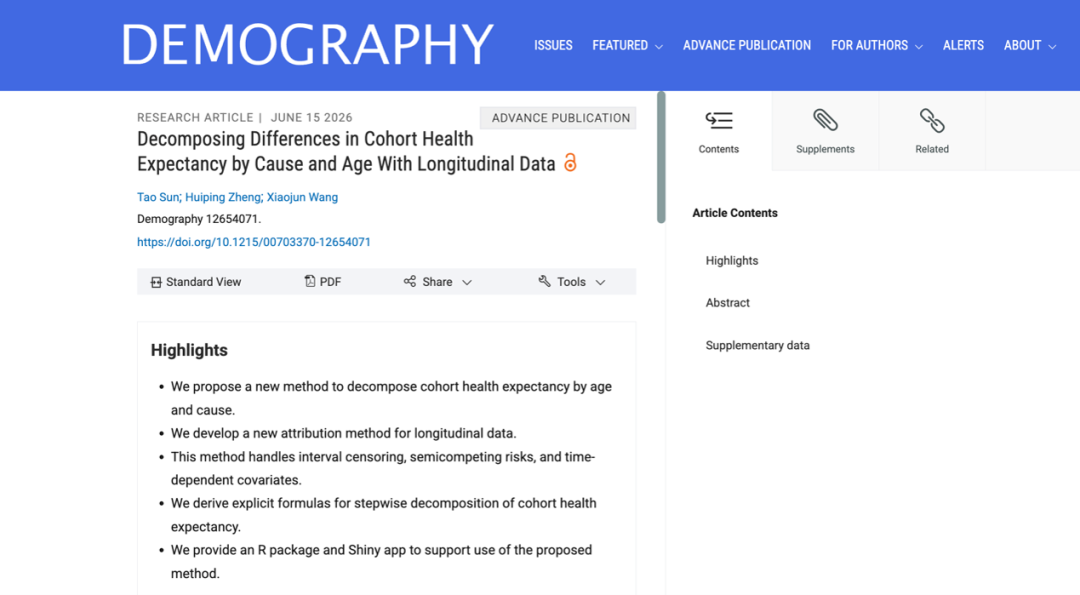
为什么有的人群能够拥有更长的健康预期寿命?不同出生队列、社会经济群体或地区之间健康预期寿命(Health Expectancy)的差异究竟来源于哪些因素,又集中发生在哪些年龄阶段?长期以来,健康预期寿命已成为衡量健康老龄化的重要指标,但现有研究多侧重于描述差异的大小,难以进一步揭示其形成机制。针对这一问题,中国人民大学统计学院王晓军教授团队提出了一种基于纵向随访数据的健康预期寿命归因—分解新方法,实现了从年龄和影响因素两个维度解析不同人群健康预期寿命差异的来源。与传统基于横断面数据的方法相比,该方法能够利用个体长期随访信息,更准确地刻画健康变化和死亡过程,并进一步量化不同影响因素在不同年龄阶段对健康预期寿命差异的具体贡献。该框架所考虑的影响因素不仅包括疾病和死因,也可以扩展至生活方式、社会经济条件、环境暴露以及遗传风险等多种因素。该研究不仅能够回答“健康预期寿命差异有多大”,更能够回答“健康预期寿命差异从哪里来”,为识别影响健康老龄化的关键因素和关键年龄窗口提供了新的统计工具。与此同时,团队开发了配套软件包 LongDecompHE 和可视化 Shiny 平台,方便研究人员开展健康预期寿命的测算、归因与分解分析。该研究为理解人口健康不平等、优化慢性病防控策略以及推进健康中国和积极应对人口老龄化国家战略提供了新的方法学支撑。相关成果以“Decomposing Differences in Cohort Health Expectancy by Cause and Age with Longitudinal Data”为题发表于人口学领域国际顶级期刊《Demography》(https://doi.org/10.1215/00703370-12654071)。
论文题目
Decomposing Differences in Cohort Health Expectancy by Cause and Age With Longitudinal Data
论文摘要
Cohort health expectancy, rather than period health expectancy, is a more appropriate measure for describing the health trajectories of specific cohorts. Decomposing the differences in cohort health expectancy by cause (i.e., disease) and age helps us to better understand and alleviate health disparities between subcohorts. However, there is a lack of effective decomposition methods for cohort health expectancy. The key to such a decomposition is additively attributing disability and death to specific ages and causes, a step known as attribution. Existing attribution methods are usually designed for cross-sectional data and thus cannot effectively capture the temporal association between causes and disability or death in a cohort. We propose a novel longitudinal attribution method that calculates age‒cause-specific contributions to disability and death in a cohort during longitudinal follow-up. We then present a new longitudinal decomposition method for the differences in cohort health expectancies based on the attribution results. Finally, we illustrate the proposed methods by decomposing the sex difference in cohort health expectancy using a longitudinal dataset of older Chinese individuals. These methods were implemented in a user-friendly online application (https://zhenghp.shinyapps.io/PC-HE_decomp/) and the freely available R package {LongDecompHE}.
作者介绍

孙韬,中国人民大学统计学院副教授,博士毕业于美国匹兹堡大学生物统计系。主要研究方向为复杂生存数据建模、健康老龄化统计方法、老年失能失智风险管理以及人工智能驱动的疾病风险预测。研究成果发表于Biometrics, Demography, Age and Ageing等统计学、人口学和老年学期刊。主持国家自然科学基金青年项目、面上项目及全国统计科学研究重点项目。

郑卉萍,中国人民大学统计学院2022级博士研究生。研究方向包括老年健康遗传机制、健康预期寿命建模、死亡率分析及人口统计方法。论文发表于Demography,Journal of Gerontology Series A,《中国人口科学》等期刊。

王晓军(通讯作者),中国人民大学吴玉章讲席教授,统计学院教授。国家统计专家咨询委员会委员,兼任中国统计教育学会副会长、国务院学位委员会统计学学科评议组召集人、全国应用统计专业学位研究生教育指导委员会秘书长、国家统计局-中国人民大学数据开发中心执行主任。主要从事人口统计、人寿保险、养老金、社会保障以及与健康相关的风险量化模型与应用研究。
论文发表截图
中国人民大学健康大数据研究院于2023年5月获批成立,为学校首批建设的16个创新高地之一。研究院聚焦国民健康中的数据科学挑战,面向国民健康测度、评估、管理等社会重大现实问题开展基础研究与应用研究,致力于服务“健康中国”国家战略重大需求、构建健康大数据领域国内领先、国际一流的创新型研究高地。
Copyright ©2016 中国人民大学科学技术发展部 版权所有
地址:北京市海淀区中关村大街59号中国人民大学明德主楼1121B 邮编:100872
电话:010-62513381 传真:010-62514955 电子邮箱: ligongchu@ruc.edu.cn
京公网安备110402430004号