
信息来源:RUC应用统计科学研究中心 发布日期:2026年5月25日
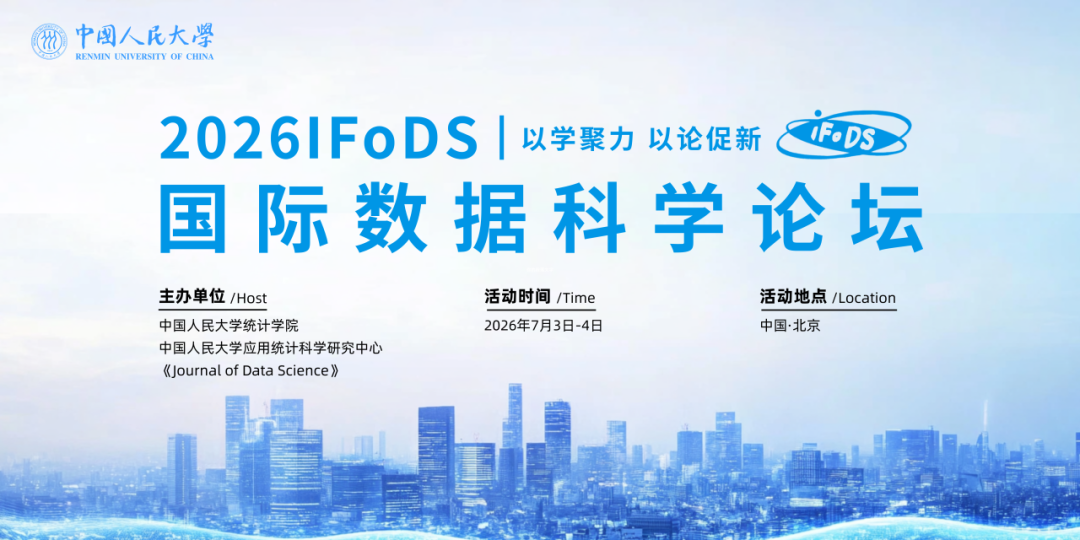
全程免费参会 无注册费用,开放报名
多位大咖领衔 国际顶尖学者齐聚
形式丰富多元 短课+主论坛+平行分论坛
2026年7月3日-4日,由中国人民大学统计学院、中国人民大学应用统计研究中心与《Journal of Data Science》共同主办的国际数据科学论坛(IFoDS 2026)将于北京启幕。本次论坛旨在为全球数据科学领域的科研人员、行业从业者、专业学者与青年学子,搭建开放、多元、高端的学术交流平台。通过短课、主题演讲、多主题平行分论坛等形式,激发前沿对话、启迪学科洞见、探索交叉创新,推动全球学术资源共享,助力数据科学实现持续创新与高质量发展。诚挚邀请海内外各界同仁关注并报名参与本次论坛。
本期为您预告大会主题演讲嘉宾及报告内容。
一、大会主题演讲
Title:Continuous Normalizing Flows for Generative Modeling and Applications(用于生成建模及其应用的连续归一化流)
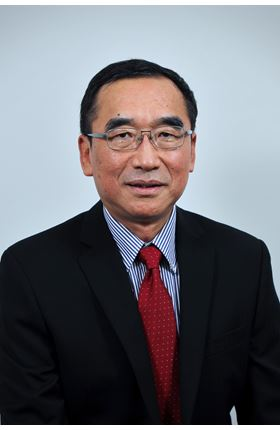
Dr. Jian Huang is a Chair Professor of Data Science and Analytics in the Department of Applied Mathematics at The Hong Kong Polytechnic University. He obtained his Ph.D. degree in Statistics from the University of Washington in Seattle. His current research interests include deep generative models and inference, statistical inference in deep learning, deep neural network approximation theory, representation learning, and statistical analysis leveraging pretrained large models. He has published widely in the fields of Statistics, Biostatistics, Machine Learning, Bioinformatics and Econometrics. He was designated a highly cited researcher in the field of Mathematics from 2015 to 2019 by the Web of Science group at Clarivate and included in the list of top 2% of the world's most cited scientists by Elsevier BV and Stanford University (2019-2024). He serves on the editorial boards of the Journal of the American Statistical Association and Journal of the Royal Statistical Society (Series B). Professor Huang is a fellow of the American Statistical Association and a fellow of the Institute of Mathematical Statistics.
Abstract: Continuous Normalizing Flows (CNFs) have emerged as a powerful class of generative models, distinguished by their capacity for both high-fidelity sample generation and highly expressive density modeling. By leveraging neural ordinary differential equations (ODEs), CNFs construct a continuous-time, invertible mapping that smoothly transforms a tractable base distribution, such as standard Gaussian, into a complex, high-dimensional target data distribution. In this talk, we will explore the theoretical foundations and computational mechanisms underpinning CNFs. Building on these principles, we will examine the versatility of this framework across a broad spectrum of modern statistical and machine learning tasks. Specifically, we will highlight how the exact invertibility and tractable density evaluation inherent to CNFs can be uniquely leveraged to characterize conditional independence, advance counterfactual estimation in causal inference, provide rigorous uncertainty quantification in conformal prediction, and enable dynamic trajectory modeling in motion generation.
Title:Speech Emotion and AI-Driven Intelligent Marketing(语音情感识别与人工智能驱动的智能营销)
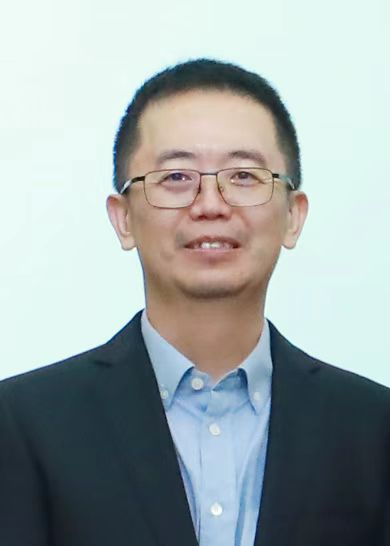
Dr. Hannsheng Wang is Professor and PhD Supervisor, Department of Business Statistics and Econometrics, Guanghua School of Management, Peking University. He is a recipient of the National Science Fund for Distinguished Young Scholars, a Changjiang Distinguished Professor appointed by the Ministry of Education, and the Founding President of the Young Statisticians Association of the Chinese Industrial Statistics Teaching and Research Association. He is an IMS Fellow, ASA Fellow, and Elected Member of the ISI. He has served as Associate Editor or Editor for 10 international academic journals. He has published over 200 papers in professional journals worldwide, co-authored one English monograph and five Chinese textbooks. He has been selected as an Elsevier Highly Cited Chinese Researcher in Mathematics (2014–2019), Applied Economics (2020), and Statistics (2021–2025).
Abstract:This report focuses on speech emotion recognition technology and its applications in AI-driven intelligent marketing, examining three practical scenarios in the automotive industry: live streaming and short-video marketing, telemarketing, and AI tele-robot marketing, to explore its technical framework, implementation, and business value. For live streaming and short-video marketing, a CNN-based speech emotion recognition model is built using a dataset of 9,303 audio clips with MFCC features to quantify hosts’ positive emotions, a key factor in conversion. For telemarketing customer conversion prediction, an emotion-enhanced dual-attention model fusing speech Mel spectrograms and textual dialogue data is proposed, achieving an AUC of 0.921 and significantly improving efficiency while reducing costs. The report also establishes a state-space model-based AI tele-robot framework integrating ASR, TTS, and large language models, with continuously enhanced conversion performance. Finally, a theoretical framework for intelligent speech marketing centered on cost, trust, and benefit is proposed, highlighting the technology’s extensibility to education, healthcare, and public sectors and providing a reference for the integration of speech technology and digital marketing.
Title:Statistics Beyond Models: Data, Decisions, and Workflows(超越模型的统计学:数据、决策与流程)
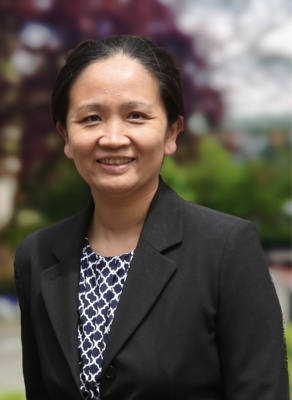
Dr. Tian Zheng Professor of Statistics at Columbia University. She obtained her Ph.D. from Columbia in 2002. In her research, she develops novel methods for exploring and understanding patterns in complex data from different application domains such as biology, psychology, climatology, and etc. Her current projects are in the fields of statistical machine learning, spatiotemporal modeling, and social network analysis, collaborating with ecologists and earth scientists. Professor Zheng’s research has been recognized by the 2008 Outstanding Statistical Application Award from the American Statistical Association (ASA), the Mitchell Prize from ISBA, and a Google research award. She became a Fellow of the American Statistical Association in 2014. Professor Zheng is passionate about education and mentoring. From 2015-2016, she was one of the series creators for Columbia’s edX Massive Online Open Course (MOOC) series on data science. From 2017-2020, she was associate director for education of Columbia Data Science Institute. She led a number of education programs, including the MS in Data Science program at Columbia, data science capstone projects with data ethics components, DSI Scholars program that connects students with academic research projects in data science, the Collaboratory program for interdisciplinary data science curriculum development, a number of popular Data Science boot camps. She created DSI’s working group on Data Science Education and has been coordinating data science education efforts across Columbia. Professor Zheng is the receipt of the 2017 Columbia’s Presidential Award for Outstanding Teaching. In 2021, she was recognized by a Lenfest Distinguished Columbia Faculty Award that recognizes the excellence of faculty as teachers and mentors of both undergraduate and graduate students.
Abstract:With the rise of data science and AI, statistical reasoning increasingly operates within workflows that link data processing, analysis, and decision-making, often extending beyond the boundaries of individual statistical models. The growing use of generative AI tools in these workflows can distance data-driven practice from statistical rigor when used without appropriate guardrails, but it also creates opportunities for statisticians to play a more central role in designing, evaluating, and overseeing end-to-end data workflows as technical barriers to entry are lowered. In this talk, I draw on collaborations in climate science, ecology, and public health research to show how key statistical challenges arise across workflows, including the “first mile” of data processing and the “last mile” of translating results into insights. I conclude by discussing implications for statistical research training, arguing that working across workflows, experimenting with and evaluating automated analyses, and understanding how uncertainty propagates to decisions are becoming central to statistical education.
点击官网链接查看更多会议详情:
https://statds.org/events/ifods2026/index.html
二、报名方式
本次论坛全程免费参会,无会议费用,欢迎广大科研工作者、高校师生、行业从业者踊跃报名。
参会报名通道现已正式开启,可通过两种方式注册报名:
1.点击本文文末 “阅读原文”直接跳转报名;
2.登录论坛官方网
(https://www.wenjuan.com/s/UZBZJvqXG3/#)完成参会注册。
三、联系我们
联系人:钱老师
电话:010-62515246
地址:北京市海淀区中关村大街59号中国人民大学统计学院
以学聚力,以论促新。IFoDS 2026致力于搭建高水平国际学术互通桥梁,汇聚全球数据科学领域优质科研力量。诚邀海内外专家同仁齐聚人大,共探学科前沿、共研创新成果、共拓数据科学发展新边界!
Copyright ©2016 中国人民大学科学技术发展部 版权所有
地址:北京市海淀区中关村大街59号中国人民大学明德主楼1121B 邮编:100872
电话:010-62513381 传真:010-62514955 电子邮箱: ligongchu@ruc.edu.cn
京公网安备110402430004号