
信息来源:中国人民大学健康大数据研究院 发布日期:2026年5月5日

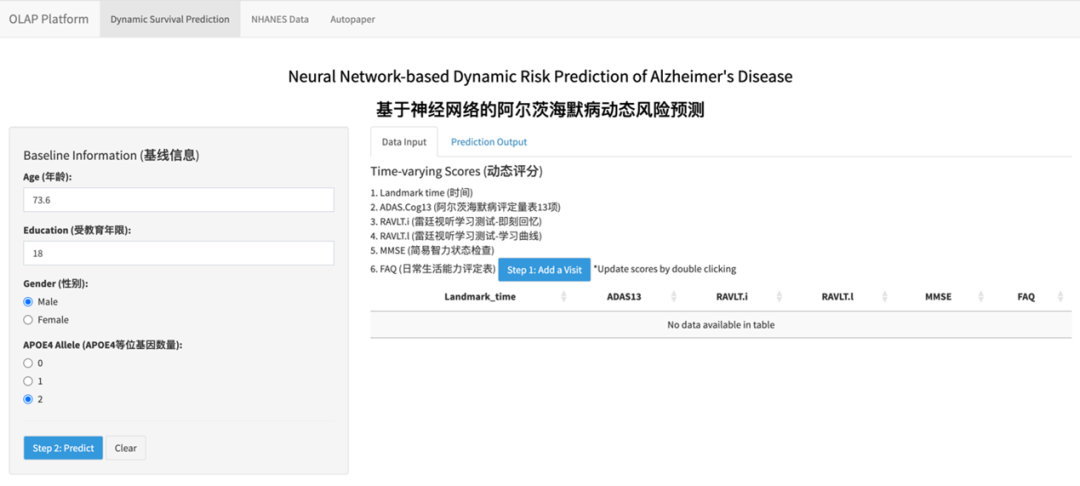
随着人口老龄化加速,如何实现阿尔茨海默病(Alzheimer’s disease, AD)的早期识别与动态风险预测,已成为公共健康领域的关键问题。然而,现实研究中常面临随访时间不精确(区间删失)以及认知指标随时间动态变化等复杂数据挑战,传统方法难以充分利用这些信息。针对这一问题,我院团队提出了一种融合神经网络与多变量函数主成分分析(MFPCA)的动态预测模型,可在区间删失框架下有效整合多维纵向认知与功能数据,实现个体化风险评估。基于模拟研究与阿尔茨海默病神经影像计划(ADNI)数据的实证分析表明,该方法在预测准确性和稳定性方面均优于现有主流方法,能够更精准地刻画疾病进展过程。进一步地,团队开发了在线应用平台(http://olap.ruc.edu.cn/),支持个体化动态风险预测与可视化展示,为科研人员和临床实践提供便捷工具。该研究不仅在方法学上拓展了复杂生存数据建模与机器学习的交叉研究,也为阿尔茨海默病的早期筛查与精准干预提供了新的技术手段。
1 作者介绍

刘可昕
杜兰大学生物统计系博士研究生,2024年硕士毕业于中国人民大学统计学院。主要研究方向包括生存分析,因果推断等。

祖一宁
中国人民大学统计学院2024届硕士毕业生,主要研究方向为复杂生存数据的分析与应用、流行病学研究等。

易丹辉
中国人民大学教授、博士生导师。研究方向:预测与决策、风险管理与保险、生物医学统计。主持国家自然科学基金、国家社科基金、国家“十一五”科技支撑计划等及企事业委托项目百多项。

丁颖
匹兹堡大学生物统计与健康数据科学系终身教授。研究兴趣涵盖生存分析、大规模多组学数据分析、多重比较方法以及精准医学。她为美国统计协会会士,同时兼任匹兹堡大学研究生院学术事务副院长。

孙韬
通讯作者,中国人民大学统计学院副教授,博士毕业于匹兹堡大学生物统计系。研究方向包括复杂生存数据建模、老年失能失智风险管理、基于神经网络的复杂疾病风险预测。主持国家自然科学基金青年项目和面上项目,全国统计科学研究重点项目。
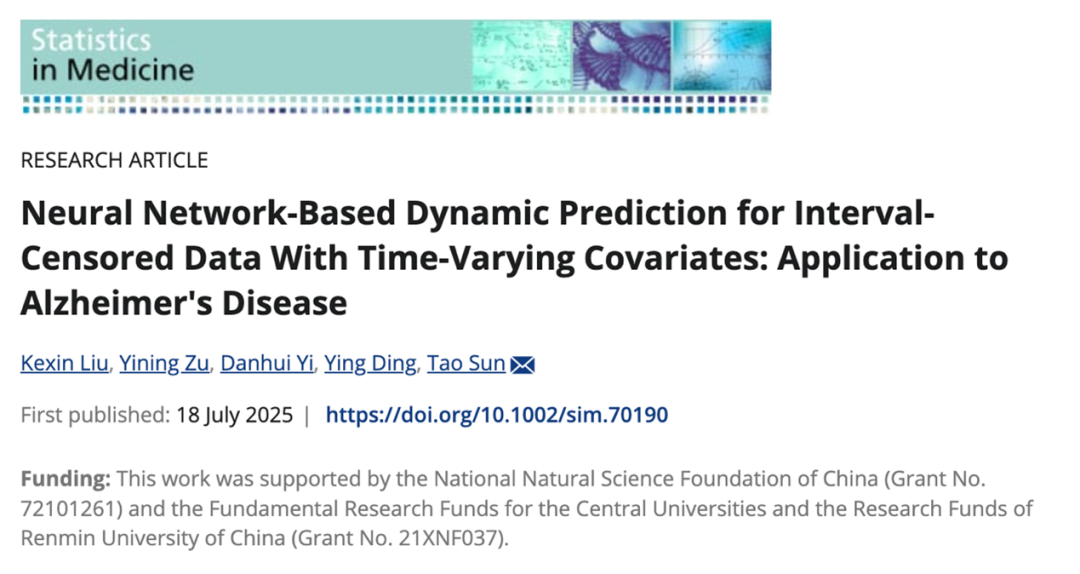
2 论文发表截图
3 应用平台截图
4 论文题目
Neural Network-Based Dynamic Prediction for Interval-Censored Data with Time-Varying Covariates: Application to Alzheimer's Disease
5 论文摘要
Alzheimer's disease (AD) is a progressive neurodegenerative disorder accounting for a significant proportion of global dementia cases. Given the lack of effective treatments, there is growing interest in dynamic prediction methods for timely interventions. Notably, many at-risk individuals with periodic clinic visits provide dynamic cognitive and functional scores. When an individual receives a new score at each follow-up, the dynamic prediction model can integrate the individual's historical scores with the new follow-up scores to offer an updated risk prediction. This study utilizes a comprehensive dataset from the four phases of the Alzheimer's Disease Neuroimaging Initiative (ADNI) study, comprising 1702 individuals with multiple time-varying cognitive and functional scores and baseline covariates. We address several challenges: Interval-censored time-to-AD due to intermittent assessments, multiple time-varying covariates, and nonlinear covariate effects on AD development. The proposed approach integrates multivariate functional principal component analysis with a neural network; the former extracts important predictive features from multiple time-varying covariates, while the latter handles the nonlinear covariate effects on interval-censored time-to-AD. This method facilitates individualized and dynamic predictions for AD development. Based on simulation results and application to the ADNI dataset, the proposed method outperforms several other methods in terms of prediction accuracy. Furthermore, it identifies high- and low-risk subgroups with distinct progression risk profiles at each landmark time, enabling early and timely intervention of AD. To facilitate dynamic predictions in practice, we have developed an online prediction platform accessible at http://olap.ruc.edu.cn.
中国人民大学健康大数据研究院于2023年5月获批成立,为学校首批建设的16个创新高地之一。研究院聚焦国民健康中的数据科学挑战,面向国民健康测度、评估、管理等社会重大现实问题开展基础研究与应用研究,致力于服务“健康中国”国家战略重大需求、构建健康大数据领域国内领先、国际一流的创新型研究高地。
Copyright ©2016 中国人民大学科学技术发展部 版权所有
地址:北京市海淀区中关村大街59号中国人民大学明德主楼1121B 邮编:100872
电话:010-62513381 传真:010-62514955 电子邮箱: ligongchu@ruc.edu.cn
京公网安备110402430004号