
信息来源:中国人民大学健康大数据研究院 发布日期:2026年1月12日
随着人口老龄化进程的加快,老年失能已成为影响生活质量和社会发展的重大公共健康问题。尽管遗传因素在失能发生中发挥着重要作用,但相关的全基因组关联研究仍十分有限。近日,我院王晓军教授团队首次开展了基于生存分析模型的全基因组关联研究(GWAS),系统探索影响老年失能发展的遗传风险。研究利用加拿大老龄化纵向研究(CLSA)老年人随访数据,发现6个全基因组显著位点和134个潜在风险位点,并在英国生物样本库(UKB)中得到部分验证。进一步的转录组关联分析、基因集与组织富集分析揭示了炎症调控、神经发生及代谢过程等关键生物学通路。团队还首次构建了失能发展的多基因风险评分(Polygenic Hazard Score, PHS), 并证实其与人口学及环境因素结合后能显著提升预测性能。同时,团队开发了可视化与个体化风险评估的在线应用平台(https://zhenghp.shinyapps.io/disability_COXGWAS/),支持GWAS结果的交互式展示及个体PHS分数的计算,为老年失能风险的预测建模和靶向预防提供了新的科学依据。本研究在老年失能遗传学领域提供了新的证据,并为建立更精准的风险预测模型与干预策略奠定了重要基础。该成果发表于老年学权威期刊Journals of Gerontology: Series A(https://doi.org/10.1093/gerona/glaf185)。
1
作者介绍

郑卉萍
中国人民大学统计学院2022级博士研究生。研究方向包括老年健康遗传机制、健康预期寿命、健康不平等及人口统计模型。论文接收或发表于Demography,Journal of Gerontology Series A等期刊。

孙韬
中国人民大学统计学院副教授,博士毕业于匹兹堡大学生物统计系。研究方向包括复杂生存数据建模、老年失能失智风险管理、基于神经网络的复杂疾病风险预测。主持国家自然科学基金青年项目和面上项目,全国统计科学研究重点项目。

王晓军
中国人民大学吴玉章讲席教授,统计学院教授。国家统计专家咨询委员会委员,兼任中国统计教育学会副会长、国务院学位委员会统计学学科评议组召集人、全国应用统计专业学位研究生教育指导委员会秘书长、国家统计局-中国人民大学数据开发中心执行主任。主要从事人口统计、人寿保险、养老金、社会保障以及与健康相关的风险量化模型与应用研究。
2
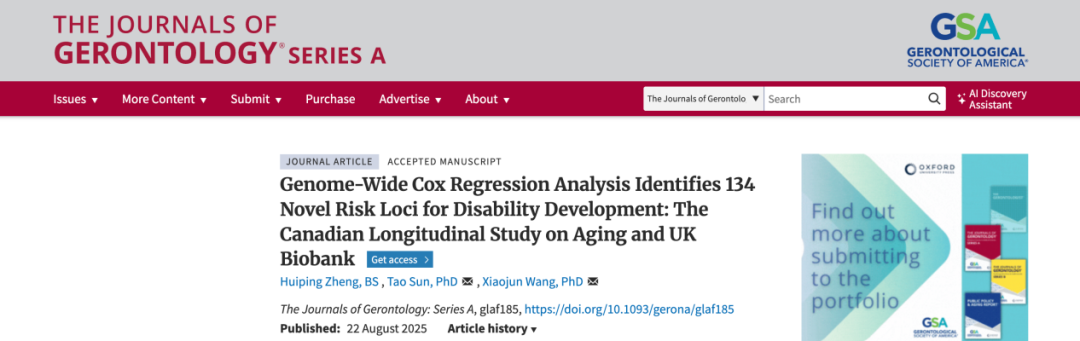
论文发表截图
3
论文题目
Genome-Wide Cox Regression Analysis Identifies 134 Novel Risk Loci for Disability Development: The Canadian Longitudinal Study on Aging and UK Biobank
4
论文摘要
Background: Disability significantly affects the well-being of older adults and imposes substantial personal and social burdens. Although genetic effects play a role in disability, large-scale genome-wide association studies (GWAS) of disability development remain scarce.
Methods: We performed the first Cox proportional hazards GWAS on disability development on 8,421 individuals aged 65 and older from the Canadian Longitudinal Study on Aging (CLSA). Disability was defined as the inability to perform daily activities, as measured by the Activities of Daily Living (ADL) scale. A polygenic hazard score (PHS) was developed and incorporated into the predictive model, along with demographic and environmental factors.
Results: The study observed a 16.28% incidence of disability over a mean follow-up duration of 4.64 years (SD = 1.95). The COX-GWAS identified six genome-wide significant variants (p < 5E-08) and 134 independent SNPs with suggestive significance level (p < 1E−05). Replication in the UK Biobank confirmed that rs589819, rs56294014, and rs143714258 remained nominally significant and exhibited consistent effect directions. Post-GWAS analyses, including transcriptome-wide association studies TWAS, gene set, and tissue enrichment analyses, revealed genetic pathways related to inflammation regulation, neurogenesis, and metabolic processes. Incorporating PHS with demographic and environmental factors improves the prediction performance in both CLSA and UKB.
Conclusion: This study is among the first genome-wide Cox regression analyses to uncover novel genetic loci and biological pathways involved in disability development in older adults. These findings provide a foundation for predictive modeling and targeted prevention strategies.
中国人民大学健康大数据研究院于2023年5月获批成立,为学校首批建设的16个创新高地之一。研究院聚焦国民健康中的数据科学挑战,面向国民健康测度、评估、管理等社会重大现实问题开展基础研究与应用研究,致力于服务“健康中国”国家战略重大需求、构建健康大数据领域国内领先、国际一流的创新型研究高地。
Copyright ©2016 中国人民大学科学技术发展部 版权所有
地址:北京市海淀区中关村大街59号中国人民大学明德主楼1121B 邮编:100872
电话:010-62513381 传真:010-62514955 电子邮箱: ligongchu@ruc.edu.cn
京公网安备110402430004号