
信息来源:中国人民大学健康大数据研究院公众号 发布日期:2026年8月3日

T形子宫是一种罕见的子宫畸形,尽管在普通人群中患病率相对较低,但在不孕症患者中显著升高,且与不良妊娠结局密切相关。目前,T形子宫尚无普遍标准化的诊断标准。近年来,三维经阴道超声(3D-TVS)已成为评估子宫腔形态的首选无创影像学方法,但不同研究使用的参数和截断值不同,且现有研究提出的标准主要基于医生主观形态学印象,而非基于与正常生育人群的比较。本研究是在中国女性队列中,利用从3D-TVS冠状面获得的精确且可重复的测量值,客观比较正常子宫与T形子宫的形态,并基于这些测量值,开发了三步序贯策略,为T形子宫提供了客观、准确且可重复的诊断方法,有效减少了诊断中的不确定性。
1
作者介绍
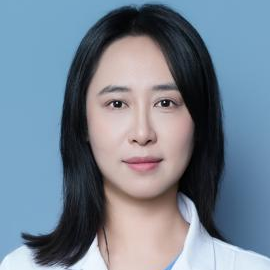
李斯静
李斯静,中国人民大学流行病与卫生统计学硕士,在首都医科大学附属北京妇产医院及复兴医院从事妇产科超声工作20余年,擅长妇产科疾病超声诊断及鉴别诊断,腹腔镜超声术中评估及定位,胎儿畸形的产前筛查。

王瑜
王瑜(共同一作),中国人民大学统计学院副教授,北京生物医学统计与数据管理研究会副秘书长、国家食品药品监督管理总局医疗器械技术审评专家咨询委员会委员、中华预防医学会健康保险专业委员会委员、北京医学会健康管理学分会质量控制与改进学组委员、中国健康促进与教育协会健康管理分会委员。主要从事医疗保障、健康调查、老龄化、指数分析、医疗数据分析等方面的研究。研究论文发表在Journal of Affective Disorders、Public Health、BMC Public Health、 Scientific Reports、PLoS One、BMC Health Services Research等杂志上。主持了国家社会科学基金项目、中国人民大学研究品牌计划基础研究项目等。

李天照
李天照(通讯作者),亚太生殖医学会(Aspire)前任主席,香港大学医学博士、香港中文大学教授、英国谢菲尔德大学荣誉教授,英国格拉斯哥皇家医学院、英国皇家妇产科医学院荣授院士,首都医科大学附属复兴医院妇产科主任、首都医科大学名誉教授,国际知名的生殖医学专家、北京“海聚工程”特聘专家,香港Kwung Wah教学医院客座教授,英格兰北部妇产科学会、英国不孕学会英国人类生殖及胚胎学会、美国生殖医学学会、英国医学会、英国妇科内镜学会、欧洲妇科内镜学会教授级会员。主持北京市科委“首都临床特色应用研究”1项;主持香港创新科学基金和工业配套资金、香港中文大学直接拨款、香港妇产科信托基金等多个科研基金项目,发表相关学术论文300余篇,参编论著18部、主编《Chronicpelvicpain》一部。

黄晓武
黄晓武(通讯作者),首都医科大学附属复兴医院宫腔镜诊治中心主任,教授、博士生导师。北京医学会妇产科分会委员,亚太生殖协会(Aspire)生殖外科学组组长(Chairperson),中国医师协会妇科微创委员会宫腔镜工作组副组长,中国妇幼保健协会宫内疾病防治委员会副主任委员,中国妇幼保健协会妇幼微创分会宫腔镜学组副组长兼秘书,中国医疗保健国际交流促进会生殖医学分会常委,中国医师协会生殖医学分会委员、生殖外科学组委员。
作者贡献:
李斯静:临床病例资源提供,研究方案设计,论文初稿撰写,统计数据分析;
王瑜:统计学方法指导,统计数据核查校验,数据可视化制作指导;
李天照:整体研究方案统筹指导,全文稿件审阅;
黄晓武:全文审定定稿,研究结果解读,论文关键内容修订;
全体作者: 均通读并确认论文最终版本。
*文中仅列主要作者,全部作者信息请前往期刊官网查阅论文原文。
2
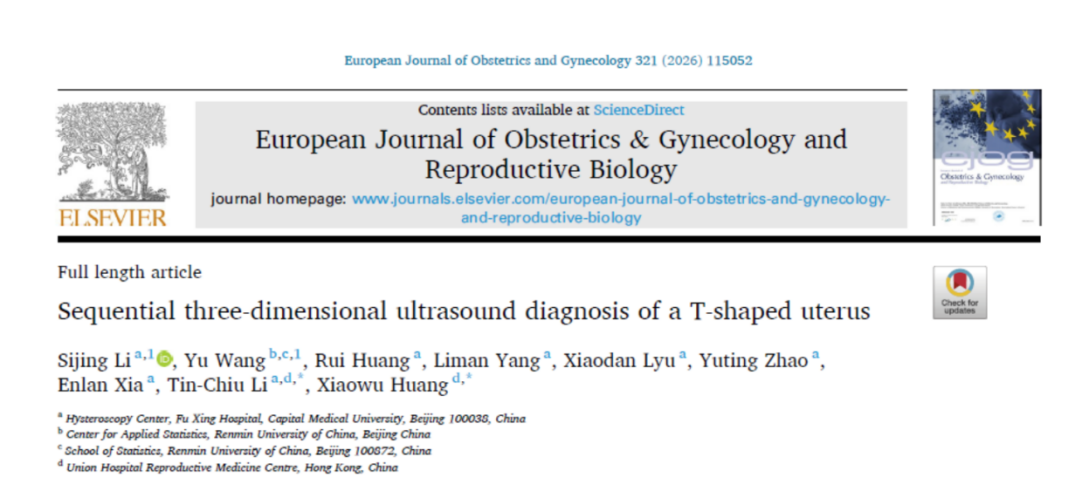
论文发表截图
3
论文题目
Sequential three-dimensional ultrasound diagnosis of a T-shaped uterus
4
报告摘要
Objectives:
To develop a pragmatic and precise diagnostic approach for a T-shaped uterus.
Study design:
This retrospective case-control study was conducted at a national referral center for congenital uterine malformations in Beijing, China, with cases enrolled between July 2021 and June 2024 and controls recruited between August and November 2025. Fifty patients with a T-shaped uterus were identified as the case group and diagnosed by a panel of 12 experts through blinded independent assessment of three-dimensional transvaginal ultrasonography (3D-TVS) and hysteroscopic findings (consensus, ≥7/12). A control group of 50 fertile women with functionally normal uteri was prospectively recruited. All ultrasound examinations were performed during the secretory phase. Thirteen quantitative sonographic parameters were analyzed. Least Absolute Shrinkage and Selection Operator (LASSO) regression was used to identify candidate predictors. Based on LASSO coefficients and clinical relevance, three key parameters-cavity width at the level of lateral wall indentation, average lateral internal indentation depth, and upper cavity depth-were selected for the diagnostic model. Single-parameter and sequential (two- and three-step) strategies were evaluated using receiver operating characteristic (ROC) analysis. Sequential strategies used “grey zones” defined by 100% sensitivity or specificity thresholds in the initial steps, with final arbitration based on Youden’s index. Diagnostic performance was assessed using sensitivity, specificity, accuracy, positive predictive value (PPV), negative predictive value (NPV), and area under the curve (AUC).
Results:
Reference values for 13 secretory-phase ultrasound parameters in functionally normal uteri were established, including cavity width at the level of lateral wall indentation (95% confidence interval [CI]: 15.0–16.9 mm), average lateral internal indentation depth (95% CI: 3.9–4.6 mm), and upper cavity depth (95% CI: 13.3–15.6 mm). For single-parameter diagnosis, parameter A (cavity width ≤14 mm) achieved 100% sensitivity and 72% specificity; parameter B (indentation depth ≥5 mm) showed 100% sensitivity and 76% specificity; and parameter C (upper cavity depth ≤13 mm) yielded 98% sensitivity and 60% specificity. The two-step sequential strategy (A + B) improved specificity to 96% with a sensitivity of 90%. The proposed three-step sequential strategy (A + B + C) employed a grey-zone approach: step 1 (width 10–14 mm) triaged cases; step 2 (depth 5–7 mm) resolved ambiguity; and step 3 (upper depth ≤12 mm) confirmed the diagnosis. This combined strategy showed the highest diagnostic performance, with a sensitivity of 98%, specificity of 96%, accuracy of 97%, PPV of 96%, and NPV of 98%.
Conclusions:
The proposed 3D-TVS-based three-step sequential strategy provides an objective, accurate, and reproducible diagnostic approach for T-shaped uteri, effectively reducing diagnostic ambiguity.
中国人民大学健康大数据研究院于2023年5月获批成立,为学校首批建设的16个创新高地之一。研究院聚焦国民健康中的数据科学挑战,面向国民健康测度、评估、管理等社会重大现实问题开展基础研究与应用研究,致力于服务“健康中国”国家战略重大需求、构建健康大数据领域国内领先、国际一流的创新型研究高地。
Copyright ©2016 中国人民大学科学技术发展部 版权所有
地址:北京市海淀区中关村大街59号中国人民大学明德主楼1121B 邮编:100872
电话:010-62513381 传真:010-62514955 电子邮箱: ligongchu@ruc.edu.cn
京公网安备110402430004号